The Cash Conversion Cycle Explained for Entrepreneurs
Revenue alone does not tell the full story of a business. Many entrepreneurs generate consistent sales but still feel pressure when it comes to cash flow. The missing piece is often timing. When money comes in and when it goes out can make a significant difference in how stable a business feels day-to-day.
In the Wealth Factory framework, we look at this timing as the pulse of your Wealth Architecture. A business with high revenue but a slow cash cycle is suffering from Financial Fragmentation, where your hard-earned dollars are trapped in the 'gap' instead of working for you.
So, what is the cash conversion cycle? It is a simple but powerful way to measure how quickly a business turns its investments into usable cash. More specifically, it tracks how long cash is tied up in inventory, services, and invoices before it returns to the business.
The cash conversion cycle for entrepreneurs is especially important because growing businesses tend to feel cash flow gaps more intensely than large corporations. Understanding this cycle gives you more control over your wealth architecture and helps you make better decisions.
At its core, the concept is built around the cash conversion cycle formula, which we will break down to help you find the "leaks" in your system.
What Is the Cash Conversion Cycle for Entrepreneurs?
At a high level, what is the cash conversion cycle measuring? It measures the amount of time it takes for a business to spend money on operations and then recover that money through customer payments.
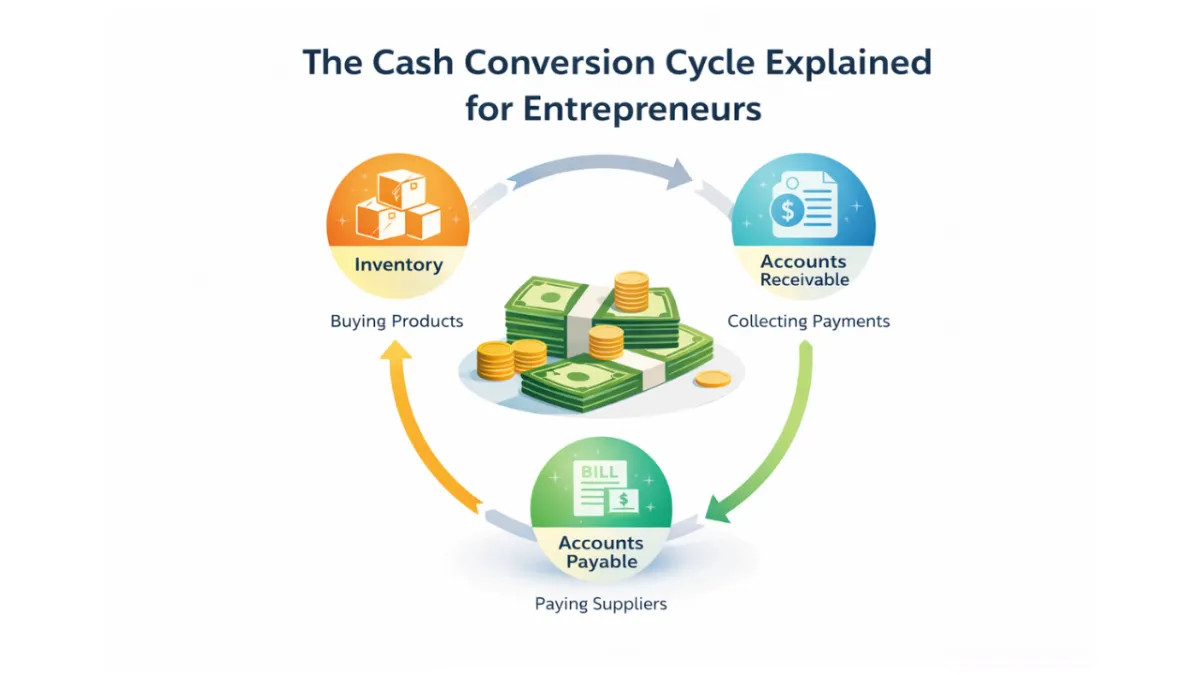
The cash conversion cycle for entrepreneurs focuses on three main stages: how long inventory sits, how long customers take to pay, and how long you take to pay suppliers. Together, these determine your "cash gap."
Why Timing Matters More Than Revenue
A business can be profitable and still struggle financially if cash is delayed. This is known as the "Growth Trap"—where selling more actually makes you "broader" but "thinner" on cash. For example, if you pay for inventory today but do not get paid for 60 days, your business must "float" those costs for two months.
This is why the cash conversion cycle matters in practical terms; it reveals the hidden gaps that a standard Profit & Loss statement cannot show.
Inventory Period in the Cash Conversion Cycle for Entrepreneurs
The inventory period measures how long products sit before they are sold. For product-based businesses, this is often the largest "cash trap."
Within the cash conversion cycle for entrepreneurs, a longer inventory period means your money is sitting on shelves as physical objects instead of being available as liquid capital.
Ways to Improve Inventory Efficiency
Demand Forecasting: Align purchasing with real-time sales data rather than "gut feelings."
Purge Slow-Movers: Identify stock that hasn't moved in 90 days and liquidate it to free up cash.
Supplier Lead Times: Negotiate smaller, more frequent shipments to keep less cash tied up at once.
Improving this stage is one of the most practical ways to strengthen the cash conversion cycle for entrepreneurs and free up working capital for higher-yield investments.
Accounts Receivable Period and Cash Flow Delays
The accounts receivable period measures how long it takes to collect payment after a sale. In the cash conversion cycle for entrepreneurs, delayed payments act like an interest-free loan you are giving to your customers.
How to Reduce Collection Time
Immediate Invoicing: Don't wait to send invoices, follow the agreed schedule with your customers.
Incentivize Speed: Offer a small discount for early payments (e.g., 2/10 net 30).
Automation: Use reminders to take the "personality" out of collections.
Understanding what is the cash conversion cycle helps highlight how receivables affect your financial position. Faster collections mean more predictable cash flow and fewer surprises.
Accounts Payable Period and Strategic Timing
The accounts payable period measures how long your business takes to pay its suppliers. This is the third component of the cash conversion cycle for entrepreneurs and offers a unique opportunity for leverage.
Finding the Right Balance
Paying too quickly reduces available cash that could be used for marketing or expansion. However, paying too slowly can damage vendor relationships. The goal within the cash conversion cycle for entrepreneurs is to find a balance where payments are timed strategically to keep your cash in your accounts as long as possible without creating risk.
Cash Conversion Cycle Formula Explained
To fully understand the cash conversion cycle, it helps to look at the numbers.
The cash conversion cycle formula is:
DIO + DSO - DPO = CCC
(Days Inventory Outstanding + Days Sales Outstanding - Days Payable Outstanding)
This formula shows how long your cash is tied up during normal operations.
Inventory Days: Time products sit before being sold
Receivable Days: Time it takes to collect payment
Payable Days: Time before you pay suppliers
What the Numbers Tell You
A Positive Number: You are waiting X days for your money to return.
A Negative Number: You have "Negative Working Capital," meaning you get paid by customers before you have to pay for the products. This is the gold standard for high-growth businesses.
The cash conversion cycle formula gives you a concrete KPI to track. If your number is 45 today, your goal should be to get it to 30.
Why the Cash Conversion Cycle for Entrepreneurs Matters
The cash conversion cycle for entrepreneurs is an indicator of operational health. A shorter cycle improves liquidity, which means you have more cash available to cover expenses, invest in opportunities, and handle unexpected challenges.
Real-World Impact on Business Stability:
Reduced Debt: You don't need lines of credit to cover "gaps."
Agility: You can pounce on inventory deals or marketing opportunities because you have the cash ready.
Peace of Mind: You move from reactive "firefighting" to proactive wealth building.
Strengthening Your Cash Conversion Cycle
If your business feels financially tight despite steady revenue, the issue is likely a timing gap. The cash conversion cycle for entrepreneurs provides a clear framework for understanding the movement of your money.
By revisiting the cash conversion cycle formula monthly, you can track your progress and identify which of the three levers (Inventory, Receivables, or Payables) needs the most attention.
Managing the cash conversion cycle for entrepreneurs leads to stronger operations, increased flexibility, and the economic independence needed to build a truly sustainable business.
Disclaimer and Waiver
Wealth Factory, LLC®, its owners, officers, directors, employees, subsidiaries, service providers, content providers and agents (referred to as 'Wealth Factory') are not financial or investment advisors and not licensed to sell securities or investments. None of the information provided is intended as investment, tax, accounting or legal advice, as an offer or solicitation of an offer to buy or sell, or as an endorsement, of any company, security, fund, or other offering.
The information should not be relied upon for purposes of transacting securities or other investments. Your use of the information contained herein is at your own risk. The content is provided 'as is' and without warranties, either expressed or implied. Wealth Factory does not promise or guarantee any income or particular result from your use of the information contained herein.
Under no circumstances will Wealth Factory be liable for any loss or damage caused by your reliance on the information contained herein. It is your responsibility to evaluate any information, opinion, advice or other content contained. Please seek the advice of professionals, as appropriate, regarding the evaluation of any specific information, opinion, or other content.


